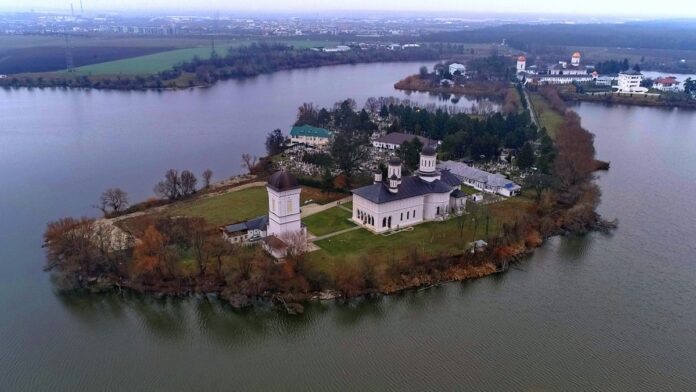
1. Cernica Monastery (Ilfov)
Description: Located just ~ 15 km east of Bucharest, on the shore of Lake Cernica, this monastery of monks is a corner of spirituality with a history of over four centuries. Cernica Monastery was documented in 1608, founded by the vornant Cernica Stirbei. Over time he has known periods of flowering, especially under the reign of the Holy Calinic de la Cernica (19th century), which raised the current large church between 1831 and 1842. Today, the complex comprises two churches (Church of St. Louis). Nicholas on “Ostrovu Mare” – the main island, and St. George’s Church on the small island), chili and bell tower, all surrounded by the quiet waters of the lake, which creates a painting of a special beauty. Monastery Park It is generous and very well-maintained, with the alleys overshadowed by lions and cypress trees where you often encounter monks passing into comfort. Cernica is also an important place of pilgrimage: in the great church are preserved the relics of St. Calinic (a famous erarch and ascet), and the monastery cemetery houses the graves of some cultural figures such as Gala Galaction, Tudor Arghezi (cenotaph) or Metropolitan Nifon. The atmosphere is one of silence and peace, Cernica being often called “an oasis of tranquility and spirituality” near the capital.
Why is it special: Cernica Monastery harmoniously combines historical, cultural and spiritual value. It was an important monastic centre, with its own printing press and church painting school, and today visitors admire both its architecture (the large church has an impressive carved iconostasis and non-Byzantine mural paintings) and its surrounding nature – the lake with nuferi and swans gives the place a special charm. Being very accessible from Bucharest, Cernica is ideal for a half-day reconnection with faith or selfAway from the noise. A tourist note: “A monastery in a picturesque setting with beautiful gardens and landscape on the lake – a perfect place for relaxation and prayer”. In addition, Cernica has local legends – it is said that on quiet nights you can hear the sunken bells of an old church in the lake, and the healing power of St. Louis. Calinic attracts many believers to his scrape.
Activity / service mentioned frequently: Those who visit Cernica often mention Walking through the monastery as being especially pleasant: the alleys covered by flowers, the banks in the shade and the view of the lake induce a calm state. It is also available Church store from the gate, where you can buy products from the monastery workshop (honey, natural syrups, icons painted by monks, religious books). Many visitors attend Sunday morning jobs, finding the choir and ritual very beautiful in the acoustics of the great church. For those interested, it is possible to visit on request and The Memorial House of St. Calinic on the premises, where objects belonging to the saint are exposed. Another default site service is silence: As the monastery is located on the islands, without traffic in the immediate vicinity, many townspeople simply come to enjoy silence, walking by the water.
Price interval: The entrance to the monastery is free. Possible donations for candles or acatists are voluntary (a candle costs 1 leu, an acatist ~ 5-10 lei). Parking nearby (on the side of the access road) is free. If you want to buy products from the store, prices are modest: for example, a honey jar ~ 20 lei, a small icon ~ 30 lei. Basically, the visit to Cernica does not involve costs, except possibly transport to there. The monastery offers accommodation for pilgrims only men (being a monastery of monks) – free of charge, within the limits of available places, usually for those who come to special jobs (previously announced telephone).
Quote from a recent review: “A wonderful place, filled with peace. The gardens of the Cernica monastery are taken care of like a park, and the lake around gives it a special charm. Ideal to reclaim and forget the commotion”. This feeling is shared by most of those who pass the threshold of the monastery – Cernica remains the most famous spiritual refuge near BucharestWhere the beauty of nature intertwines with prayer in a very special way.
Official link: Cernica Monastery – Doxology (historical presentation, chart, job program).
2. Comana Monastery (Giurgiu)
Description: Situated about 30 km south of Bucharest, in the heart of Comana Natural Park, this monastery is a special objective both through history and through its picturesque location. Comana Monastery was documented in 1461 and founded by Prince Vlad Zepes, as part of his defensive system in the pools of Neajlovului. Although the original construction fell over time, the monastery was rebuilt to the ground in 1588 by the boyar Radu Serban, acquiring the appearance of Monastery-fortress with thick brick walls that can still be seen today. The current complex includes Voivodal church (with the feast of St. Nicholas), a tower-steeple imposing gate, creneled enclosure walls and egumenical houses – all reflecting the medieval mountain style. The interior of the church was repainted in neo-Byzantine style at the beginning of the century. XX, and the courtyard is equipped with stone alleys and flowers, even having a small pond of fish, as the entire monastery is practically on a peninsula surrounded by water. A unique element of the Comanche is The Mausoleum of Heroes In 1932, at the initiative of Queen Maria and under the guidance of the historian Nicolae Iorga, the mausoleum which shelters the bones of 866 Romanian and foreign soldiers fallen in the First World War, in the battles of Neajlov. Marble plates with heroes’ names give the place a solemn air of national gratitude. Around the monastery lies the Natural Park – so-called the “Neajlovului Delta” – which makes the visit combine the recollection with the joy of nature (often see swans and lilies walking around).
Why is it special: Comana Monastery is Vlad Ttepeș’s last foundryWhich marks it in the legend of the voivod. Although not as famous as Snagov, Comana offers the opportunity to see where “Dracula” retired to build a church in the midst of the marshes – an act of faith and military strategy alike. Another reason for uniqueness is Blending between sacred and patriotic: Few monasteries house a mausoleum of heroes, and it gives the Comanche a role as a national memorial. Not least, natural frame In which it is made the memorable visit; basically, after praying or admiring the church, you can go straight out to the pier next to the walls to watch the mini-delta full of shades. Many visitors consider Comana a place unique, reminiscent of old country life with lush greenery and quiet. The abundant nature around it “fills the soul” – someone wrote – completing the peace of the place.
Activity / service mentioned frequently: Those who reach Comana often plan a full day, combining visiting the monastery with activities in the Natural Park. Thus, a “service” appreciated is possibility to rent boats or kayaks nearby, to row through the canals around the monastery after they visited her. Even the monastery has a small wharf used by pilgrims and excursions – a picturesque way to enter or exit, by boat, just like in ancient times. In the precinct, there is a small museum (unofficially – some windows) with heritage objects discovered at Comana and information about Vlad Ttepeș, which a guide monk can present. Also, pilgrims can stay overnight at Guesthouse of the monastery (modest conditions, separate for men and women), especially around the feast (St. Nicholas, December 6) or other holidays, when the monastery becomes quite animated. Finally, given the presence of Mausoleum, every year on December 1st and Heroes Day are held here military and religious ceremoniesA habit that can give visitors an emotional experience if they hit those days.
Price interval: The entrance is clear at the monastery and mausoleum. Comana Natural Park, instead, has a 5 lei / person visit fee (but there is no strict control at the monastery – practically the charge applies if you enter the trails of the park). Boat ride around the monastery costs approx. 10-15 lei / person (if any) for ~ 30 minutes. Near, Restaurant Casa Comana offers traditional lunches (soup ~ 20 lei, main dishes 30- 40 lei) – many visitors dine there after visiting. If you want souvenirs, the monastery shop sells icons, crosses, and especially materials about Vlad Zepes or the history of the place (a book about Comana ~ 20 lei, a small icon ~ 25 lei). Overall, a day at Comana is very accessible, the main costs of transport and possibly the aggression in the park, not the visit of the monastery itself.
Quote from a recent review: “Comana offers you everything: history (the foundry of Vlad Ttepeș!), nature as a delta and peace of mind. We visited the monastery – very nicely cared for – and were impressed by the mausoleum of the heroes in the premises. Then we walked down the alleys in the woods. A unique experience, two steps from Bucharest”. This theory reflects the integrated experience Comana proposes: a place where you connect with both the past and nature and faithOn one visit.
Official link: Comana Monastery – presentation (historical and guide), Comana Natural Park (tourist information).
3. Snagov Monastery (Ilfov)
Description: Snagov Monastery It is one of the most mysterious and attractive objectives around Bucharest, thanks to the joint between the beauty of the place and the legend of Vlad Ttepeș. Located on an island in the north of Lake Snagov, the monastery, fortified in the past, dates back to the 18th century and was extended by several medieval rulers. The present church, with the grace of the Lord Ascension, retains the rebuilt structure of Mircea Shepherd In 1563, but what makes it famous is the tomb in front of the altarThe tradition of which claims to shelter the remains of Vlad Ttepeș (Dracula). Although historical evidence is inconclusive, this legend gives the place an air of mystery that attracts visitors from all over the world. In addition, the monastery holds cultural records: here it was printed in 1701 the first Latin alphabet book in RomaniaThe church hosts the largest medieval fresco in the country – the walls are covered with murals (restored) illustrating dozens of saints, biblical scenes and votive portraits. Snagov Island is only accessible on water (or on an improvised pedestrian bridge, when conditions allow), which makes the visit even more special: you get off the shore and you end up in an isolated corner of the world, surrounded by rich waters and vegetation. The monastic complex includes the red brick church with its elegant steeple, the ruins of the walls of the old fortification and a small paraclis. Around it – the cemetery overshadowed by old trees, a small wharf and the waters of the lake full of trees.
Why is it special: Snagov has a legendary aura unique: the idea that Vlad Ttepeș, the hero and “monster” of Romanian folklore, would sleep forever here, attracts both pilgrims and myths. This story, combined with the boat trip to the monastery, creates a sense of historical adventure. At the same time, Snagov is a place of a natural beauty Remarkable – lake, tranquility, isolation – an environment for recuperation. Inner frescoes, well preserved, are themselves artistic treasures that would be worth visiting, illustrating post-Brancovene art from 1700. And the fact that the monastery witnessed so many events (it is said that here they took refuge in treasures, monks printed books, rulers hid from the plague at Snagov) makes it a living witness of history. As a local guide said, “who comes to Snagov comes for tranquility, culture and a bit of macabre mystery” – a description that captures the special charm of this place.
Activity / service mentioned frequently: The main activity is, of course, crossing by boat. There are taxi boats leaving the wharf in Silistea Snagov village (the cost varies by group, ~ 10-20 lei per person). The boat ride on the lake lasts only a few minutes, but it is delightful – the water is often calm, surrounded by reed, and often you will see water birds. Once on the island, guided tour of the church is highly recommended: the curator monk or local guide will show you Vlad Ttepeş’s tombstone and will tell you versions of the legend (including how his body would have been moved here after execution). You will also be highlighted scenes on frescoes – look for, for example, the rare representation of St. Christopher with a dog’s head. Visitors can still interact with small medieval object exhibition (ceramic fragments, stamped bricks), and on departure I can light candles for loved ones at the church entrance (many do this especially at Vlad’s legendary tomb). Some visitors bring flowers or crowns which he places on the grave of Ttepeș, turning him into a true altar of national hero.
Price interval: Entry to the monastery is against cost – generally 15 lei / adult and 5 lei / student / student, which contribute to the maintenance of the monument. Crossing by boat, as I mentioned, ~ 20 lei / person round-trip (if you are in a group of 6-8 people, you negotiate the price on the boat, ~ 100 lei race). If you want a guide in English, an additional donation of 10-20 lei is usually accepted. In total, an individual visitor can spend around 40-50 lei for all experience (boat + entry + possible souvenir). At the souvenir stand near the pier you can find things like “Dracula” T-shirts, magnets (10-15 lei) or wine bottles marked Vlad Zepes (~ 50 lei). Prices may be slightly higher by being a popular tourist attraction, but overall visiting Snagov is quite accessible.
Quote from a recent review: “It doesn’t look very spectacular from the outside, but the interior of the church is impressive and for me it was incredible to see the (possible) tomb of Vlad Ttepeș. The tour of the guide was full of historical information. Snagov Monastery is a hidden jewel surrounded by a beautiful landscape.”. This review (of a foreign tourist) highlights exactly the essence: Discrete splendor, charming natural context and a healthy dose of history and legend – This is why the Snagov Monastery remains at the top of the objectives near Bucharest.
Official link: Snagov Monastery – tourist guide (visiting information, program), Legends of Snagov.
4. Chiajna Monastery (Giulești, Bucharest)
Description: Chiajna Monastery is totally atypical of the other places on this list – it’s actually a Monastery in ruinswho carries with her an almost cursed story. Located on the edge of Bucharest (Giulesti-Sârbi district), the monastery was built at the end of the 18th century (started under the reign of Alexandru Ipsilanti and ended in the time of Nicolae Mavrogheni, about 1790). The church built here was monumental for that era – a massive building made of brick, neo-classical style, with walls over 1 meter thick and 3 towers. Unfortunately, never got to be sanctified: It is said that shortly after completion, an Ottoman incursion led to the partial destruction of the monastery (just before it was put into use), the monks left it, and the place remained deserted. The imposing ruins of the old church (of which only ships without roof and some of the walls are still preserved today) have stirred up many urban legends over time – about bells thrown in Dâmboviţa, about spirits that haunt the area, etc. Today, near the old monastery a new wooden church (2011) In Maramures style, to revive the spiritual life of the place. So, visiting Chiajna, you have a fascinating contrast: The old place in ruins, impressive even so, and the new monasteryThe small, wooden, full of monastic life (here serves a small family of nuns). The surrounding area is still isolated, near the dam of Lake Mori, which accentuates the strange atmosphere of forgotten ruins between the fields.
Why is it special: Chiajna Monastery is mainly sought for Its mysterious and photogenic aura. The ruins of the old church – with the fallen arches and the rough bricks of the weather – have a picturesque special, especially at sunset, when the orange light bathes them, or in winter, when the snow contrasts with the red walls. It’s a favorite place of photographers, urban explorers and paranormal enthusiasts. Legend has it that the monastery was struck by plague and curses, hence its reputation at all “cursed” (which of course attracts even more curious people). However, the presence of the new church brings hope – it’s like a reconciliation with the past, a chance of late consecration of the place. Visitors can thus see how an abandoned historical site slowly catches life again. Looking at the massive ruins you’re trying a sense of melancholy: “From the monastery of old there is still one part of the day”The rest of them being prey to history. But the new church, with the feast of St. John James and the Holy Brâncoveni, stands beside it as a symbol of the continuity of faith. In other words, Chiajna is special because it offers a visual lesson about the efferidity of worldly glory and the perennial of spiritual glory.
Activity / service mentioned frequently: Visitors mention, first of all, exploration of ruins – you can enter the old church (attention, at your own risk, being unconsolidated ruins). Many are photographed in the arch of the remaining altar or near massive counterforts. It was arranged and a small Reflecting Park: a few banks around the ruins, where you can contemplate quietly. For the faithful, the new monastery offers Regular jobs and can participate in Mass on Sunday morning (the image of the mothers singing in the wooden church with huge ruin on the background is truly touching). They’re also done. ad hoc guided tours: The nuns are happy to tell the history of the settlement and the local legends, removing the dark myths and focusing on hope and faith. In the new enclosure there are also a small church store, with icons, crosses and leaflets about Chiajna’s history (where legends are evoked). Occasionally, they happen youth camps or workshops cleaning around the ruins, volunteers helping to preserve the site. For locals, the area is also a place to walk (being close to Mori Lake), so it’s possible to see people jogging or walking dogs – a sign that the place is gradually returning to the community circuit, it’s no longer just a forgotten corner.
Price interval: The visit to the ruins and access to the new monastery are free – no charges are charged. The car can be parked at the end of the Brick Factory street (without payment, being a virane land). If you want to light a candle or leave a donation at the new monastery, they are optional (candles cost 1 leu, like everywhere). Basically, a trip to Chiajna costs only transportation. We recommend that you have appropriate shoes if you enter the ruins (rough terrain, grass). Eventually, a souvenir from the shop – a wooden icon, 10-15 lei – could be the only expense. So Chiajna is a meaningful experience, within reach of anyone financially.
Quote from a recent review: “Chiajna Monastery in ruins gives you the creeps – huge, silent, yet impressive walls. It’s sad and beautiful at the same time. Next to it, the new wooden church, very neat, it seems to comfort the sad story. A place like I’ve never met, worth seeing at sunset!”. Many reports highlight this mix of contrasting feelings which Chiajna wakes up: melancholy, curiosity, but also hope. Certainly, the visit to Chiajna monastery – otherwise less known – offers one of the most unusual cultural and spiritual experiences near Bucharest.
Official link: Chiajna Giulești Monastery – Facebook (page of the monastic community with novelties), “Curse of Chiajna Monastery” – The Truth (historical and legends).
5. Caldaruşani Monastery (Ilfov)
Description: Hidden between forests and lakes in the north-east of Ilfov, ~ 30 km from Bucharest, Caldarușani Monastery It is one of the oldest and richest monastic settlements in Muntenia. It was founded between 1637 and 1638 by the Voivod Matthew BasarabOn a peninsula surrounded by the waters of Lake Caldaruşani. Fortified as a small fair (it had walls and defence towers, from which it is still partially preserved), the monastery thrived over the centuries, becoming an important cultural center – there was a famous school of church painting in the 19th century. Great Church with the feast of St. Dimitrie is an impressive monument: it preserves the Brancovenian architecture, and the interior shelters an iconostas carved by a special finesse and ancient icons of the century XVIL-XVIII. One of the treasures of the monastery is His collection of ancient church art (monastery museum) – with dozens of icons on wood and glass, manuscripts and objects of silver worship. Among these are 10 icons painted by himself Nicolae Grigorescu When he was a young novice at Caldarusani (at 18 years old in 1856, the great painter apprenticed here and left behind these early works). There is also a miracle-making icon of the Mother of God, greatly worshipped by the faithful. The assembly of the monastery includes the buildings of the abbey, the cemeteries arranged around a vast well yard, and the cemetery where some important hierarchs are buried. Framed by forest and lake (where summer blooms Indians brought by Arsenie Boca, according to local tradition), Caldăruşani offers a genuine silence.
Why is it special: Caldaruşani Monastery enjoys a special spiritual and cultural heritage. Here lived and created the Holy Grigory Dascalul, a metropolitan erudite of the 19th century Romanian country whose midwives are in the church. Also here was exiled for a while the young seminarist Corneliu Zelea Codreanu (in the 1920s), an aspect related to tumultuous modern history. But beyond the personalities, the monastery impresses through the beauty of the art it shelters: from the wooden sculpture of the enchantments, to the murals and icons of Grigorescu – visitors are pleased to discover in a monastic place a real museum. “This location is often sought by Christians because of its beauty, but also for the icon of the Wonder Mother”WowBiz. The appearance of a peaceful sanctuary, sunken in nature, makes the experience at Caldaruşani profoundly reassuring – many townspeople come here especially for pray and meditate in complete silence of the monastery, away from noisy tourists. In addition, the variety of stories (from the founding voivozi, to the artists and saints) makes Caldaruşani a place where everyone finds a point of interest.
Activity / service mentioned frequently: Visiting the monastery museum is a “must” mentioned by those who arrive at Caldaruşani. Usually, a monk can open the collection for groups or upon request – there you can see the extraordinary icons painted by Grigorescu (including the two royal icons he signed), the silver-sealed gospels, the golden-embroidered priesthood of hundreds of years ago. Another special moment is participation in jobs: The Monastery of Caldarușani has a famous Psaltic choir, and the acoustics of the church add solemnness – the faithful who witnessed the Vesternians or Liturgies here describe them as very touching. Service accommodation pilgrims is also available (few simple rooms, counter-donation), so some spend a night here to enjoy the monastery’s peace at sunset and sunrise. In the nearby lake, the enthusiasts can even fish (outside the enclosure, the lake is public) – so it is not unusual for a visitor to combine the recollection with a fishing by the lake, in almost complete silence. The nuns at the pangar offer informal guidance, telling of the wonders attributed to the miracle-producing icon – it is said that whoever comes in faith and prays to the Mother of God of Caldaruşani can receive comfort in trouble, therefore every Friday read the Acatist of the Mother of God in particular.
Price interval: The entrance is clear and at the church, and at the museum (although a small donation for maintenance is recommended at the museum’s discretion). Parking is available on the side of the access road. If you choose to buy something from the pangar: candles (1 leu), icons (5-10 lei), holy ointment (5 lei bottle), etc., prices are symbolic. The accommodation at the monastery, for those interested, is made on a donation basis (however, are modest conditions of the monastic home). A special expense would be the road – Caldaruşani is not very accessible by public transport, so the ones without cars usually take a taxi from Bucharest (cost ~ 100-120 lei duh-turn) or organize themselves in groups. A tip: about 2 km from the monastery is a village (Lipia) where there is a local cheese producer, so some visitors take the opportunity to take fresh directly from the source – an authentic “souvenir” culinary at rural price (10-15 lei / kg). In conclusion, the visit to Caldarușani is very cheapthe main costs linked to transport, not the objective in itself.
Quote from a recent review: “Caldaruşani Monastery – a place where you truly feel the soul of Romanian Orthodox tradition. I was amazed at the icons that Grigorescu painted and the tranquility around. A rare beauty surrounded by lake and forest, where you seem to get closer to God.”. This comment reflects the feeling of many pilgrims and tourists: Caldaruşani offers not only a lesson in history and art, but also a profound spiritual experience, being one of the most valuable monastic settlements near Bucharest.
Official link: Caldaruşani Monastery – Basilica.ro (historical, news), TVR Reportage – Treasure from Caldaruşani (about Grigorescu’s icons).
This article is an English translation and adaptation of the original Romanian article on Lista Scurtă. Read the Romanian version.

