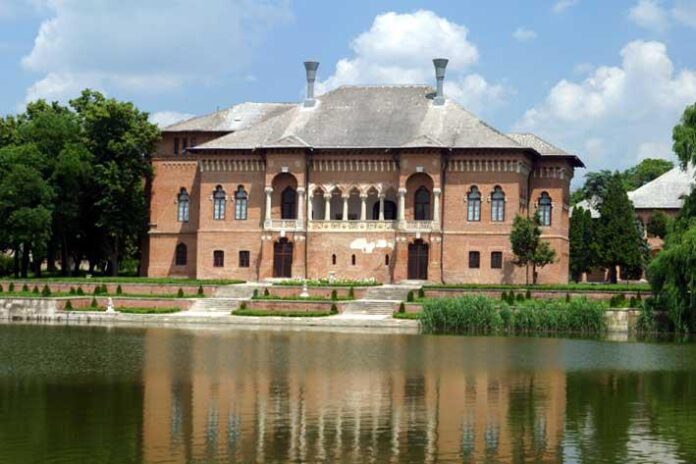
1. Mogosoaia Palace (Ilfov)
Description: Built in the early 18th century by the voivod Constantin BrancoveanuThe Mogoşoaia Palace is considered “one of the most elegant palaces in Romania”. The building is the pinnacle of style Cheeses, harmoniously combining Byzantine, Eastern and Renaissance architectural elements into a sumptuous building made of red brick. The palace, located on the shore of Lake Mogosoaia, belonged for 120 years to the Brancoveanu family and then to the Bibescu family, becoming a witness to the discretion of the Romanian aristocracy. Visitors can admire Venice facade (with the famous sculpted trilobite arcade), restored royal rooms which today host museum collections, and Cuhnia (Chewery), the watchtower, the glacier and the church “St. George” near the walls of the court. The entire field, including the English park with shady alleys and recently reconstructed greenhouses, offers visitors an atmosphere of story It’s worthy of a movie set.
Why is it special: The Mogoșoaia Palace not only impresses through architecture, but also through its historical story – here you can best understand the refinement of the Brancovenesque era. Currently, the palace houses the Museum of Aulice Traditions, where cheese icons, decorative objects and original furniture are exhibited, offering an incursion into the court life of 1700. The palace park is also an objective in itself, ideal for promenade. Many tourists appreciate quiet grandeur of the place: “The surrounding park, with the quiet lake and the shady alleys, offers an atmosphere of story”Write down the History profile website. The Mogoșoaia Palace also hosts frequently art exhibitions, concerts or cultural events, reviving the boyish spirit of old.
Activity / service mentioned frequently: Visitors often mention guided tours of the palace, which reveals fascinating details (legends about the treasures of the Brâncoveni, restoration by Martha Bibescu, etc.). Also, the café arranged in one of the annexes is regarded as a stop after the visit. For full experience, it is recommended to combine the inner tour with a walk through the palace gardens and on the lake shore – a pleasant way to spend an afternoon, just like the nobles used to do.
Price interval: Entry note at the palace is 15 lei for adults (8 lei reduced for students / pensioners). Children under 7 are free. The standard guided tours in Romanian are included in the ticket price (at fixed hours), and for guidance in foreign languages a small additional fee can be charged (~ 10- 15 lei / person). Parking within the domain costs 10 lei / car. The walk in the park is free. On the field, the prices at the cafe or souvenirs are moderate (coffee ~ 10 lei, art albums 20-30 lei). Overall, the visit to Mogoșoaia is accessible, providing an excellent relationship between cost and wealth of experience.
Quote from a recent review: “A beautiful Brancovenesque palace, as if separated from another time. The restored interior emits elegance, and the gardens of the palace, with the lake in the background, make you forget that you are only a few kilometers from Bucharest”. This feeling is shared by most tourists, who find in Mogosoaia a place alike romantic, cultural and relaxingMandatory to visit near the Capital.
Official link: The Brancovenesc Palace Mogoșoaia – Museum (program, rates, events).
2. Târgovişte Chair Fortress (Dâmbovița)
Description: Targoviste was the capital of the Romanian Country for more than three centuries, and the ruins Court from here keep the echo of the medieval history of Romania. The Târgovişte ensemble includes the foundations of the old voivodal palaces, medieval walls and churches, as well as the symbol of the fortress – the imposing Tower of Chindia, raised in the 18th century by Vlad Ttepeș. The round brick tower, about 27 metres high, once dominated the surroundings and served as a tower of security and refuge for the treasure. Today, after the 122 inner steps, offers visitors a spectacular panorama on the town of Targoviste and the subcarpathic hills of the region. The museum complex also includes ruins Great Palace (built by Peter Cercel, brother of Mihai the Brave), the Great Royal Church (1584) – splendidly restored with frescovenesti frescoes, as well as the Paraclis Church and other structures (Turkish bath, cellars, walls of enclosure). Walking among the ruins, you will feel the legendary atmosphere of the place where Mircea the Elder once reigned, Vlad Ttepeș or Constantin Brancoveanu.
Why is it special: The fortress of the Chair of Targoviste is a place loaded with national legends and symbols. This is where the story connects. a Chindia Tower by the figure of Vlad Ttepeş (associated with Dracula’s myth), and each wall stone has a story about battles for the throne, domineering intrigues or Ottoman siege. The complex was arranged as a museum, with explanatory panels and reenactments, allowing visitors to imagine the glitter of the old court. A look appreciated by tourists is site authenticity – the ruins were preserved, not artificially rebuilt, keeping the charm of the romance of the ruins. “The former capital of the Romanian Country is a place full of history and legends” stresses a presentation of the objective. Basically, Targoviştea offers the rare opportunity to Walk in the footsteps of the Voivodas literally, to climb into Vlad Ttepeș’s watchtower and look down on the former courts, knowing as well the roots and historical identity.
Activity / service mentioned frequently: Within the complex, very popular is climbing into the Tower of China, a mandatory experience for visitors (children love it and photographers enjoy wonderful frames from height). Also, tourists mention passionate local guides that sometimes offer guided tours that revives the figures of the rulers and the intrigues of the age. Periodically, the fortress hosts medieval events (festivals, reenactment with knights), which adds an interactive charm to the visit. There are also the Museum of Print and Old Book (installed in a historical home), completing the cultural agenda of the day spent in Targovişte.
Price interval: Entry note at the ensemble of the Targoviste royal court is 15 lei for adults and 8 lei reduced (students, pensioners). This ticket includes access to all the objectives of the complex, including climbing into the Tower of Chindia and the related museums (in total, a very advantageous offer). There is also the possibility of a combined ticket for all museums in Targovişte (~ 30- 40 lei) or annual subscriptions for enthusiasts. The Romanian Guide is usually free of charge, and for foreign languages a tariff can be requested (approx. 50 lei / group). Parking in the central area of Targovişte is cheap (2 lei / hour nearby). A complete visit with souvenirs (brochures, views 5-10 lei) and perhaps a lunch at a local restaurant can easily fall into a budget of 50-70 lei / person.
Quote from a recent review: “The Tower of Chindia and the ruins of the Domnești Court have transported me in time – the view from above the old fortress is impressive. A place for anyone who loves history.”. The common experience of tourists is that the visit to Targovişte offers both emotion of discovering the past as well as a moment of cultural pride, being one of the most important medieval sites near Bucharest.
Official link: The entire Royal Court Targovişte – the Dâmboviţian Museum (program, tickets).
3. Snagov Monastery (Ilfov)
Description: Situated on an island In the middle of Lake Snagov, the Snagov Monastery is an objective that combines spirituality and historical mystery. Originally founded in the 18th century and fortified in the coming centuries, the monastery bears the aura of legend because it would be buried here. Vlad Ttepeș (Dracula) – the valakian ruler of the 15th century known throughout the world. Right in front of the church altar is a tombstone that the local tradition says covers Vlad’s grave, attracting numerous visitors intrigued by this mystery. Church of the Monastery (erected in present form in 1517 by Neagoe Basarab) shelters the most extensive mural fresco preserved in a Romanian church – original 16th century paintings of exceptional artistic value. Also, Snagov printed its first Latin book in Romania in 1701, which increases the cultural importance of the settlement. Surrounded by waters and reed, the monastery offers a quiet painting: the smeared steeple mirrored in the lake, forests on the background and boats swinging ashore – an almost idyllic decoration that contrasts with the dramatic story of Vlad Zepes.
Why is it special: The Snagov Monastery is unique through its isolated location – usually arrive here by boat, crossing the lake (short trip that makes the visit even more special). Once arrived, visitors discover a modest monastic settlement in size, but Giant as Symbolistic: The old walls have survived invasions and time, and the legend of Vlad Ttepeș’s treasure (rumoured to be hidden somewhere on the island) still stirs imagination. The atmosphere on the island is very quiet and sacred – there is often only the rustling of the hive and the water birds, which amplifies the feeling of going back in time. As historian Neagu Djuvara notes, “without Snagov, the myth of Dracula would not have the same power with us”. Foreign visitors, in particular, consider Snagov a mandatory point of the “Dracula” tour, and for Romanians it is an opportunity to reflect on national history.
Activity / service mentioned frequently: The guided tours of the monastery – either organized or improvised by the service monk – are often referred to as memorable. The guide will show you The tomb of Vlad Ttepeș and will tell you the legend of his execution and bringing the body to Snagov, as well as details of the unique fresco on the walls. Also, crossing by boat It is in itself a popular activity: local pensions or leisure operators offer boats for cost, and in season, even locals can play “seamen” for tourists. The 5-10-minute walk on the lake, quietly in the morning or at sunset, complements the experience – many visitors consider it poetic. To shore (in Silistea Snagov village) there is a small wharf and souvenir stands where you can find magnetic with Vlad Ttepeș, crosses or books about the legend of Dracul a.
Price interval: Crossing by boat to Snagov Island costs approximately 20-30 lei / person (depending on the number of passengers and negotiation). Some tourist packages include Snagov, in which case the cost is already covered. Entry note at the monastery is modic– 15 lei adult, 5 lei students / students, and photo tax 10 lei. The local guide (Romanian) is usually not charged separately, but a small donation is appreciated. In total, visiting Snagov can cost less than 50 lei per person if you are in a group that shares the boat transport. For a zero budget variant, there is also an improvised pedestrian bridge from the northern shore, sometimes used by locals (but access can be unpredictable).
Quote from a recent review: “Snagov Monastery – an incredibly quiet place, despite the dark legends. The boat ride to the island was short, but unforgettable, and once there I really felt the history: Vlad Zepeș’s tomb really exists under the slab of the church!”. Most visitors leave Snagov with Strong memorieswhether you are passionate about Dracula or just about the beauty of the place – it is certainly one of the most charming and mysterious objectives near Bucharest.
Official link: Snagov Monastery – presentation (historical and legend), Info Visiting Snagov (program, contact).
4. The Stirbei Palace of Buftea (Ilfov)
Description: Just 20 km from Bucharest, in the town of Buftea, is the former domain of Prince Barbu Stirbei – an elegant boyar ensemble built in the middle of the XIXth century (about 1850). Stirbei Palace, made in Victorian neogothic style, impresses by grandeur and refinement Architectural, reminiscent of the castles of Western aristocracy. The building has a special charm, with the facade decorated by ogival windows, creels and a turn-torch, and the interior (recently restored) retains original elements: the monumental scale of oak wood, marble fireplaces, stuces and discreet mural paintings. The area extends over dozens of hectares – one The vast English park with snakes, inland lake and secular trees, originally designed by landscapers brought by the Stirbei family. Besides the palace, the complex also includes a chapel family (where members of the Stirbei family are buried), Water tower neogotic and old annexes (stables, greenhouses, hunting cabin). After the communist period in which he was a film studio, the whole ensemble passed through a vast restoration process, bringing him back to the glitter of old. Today, the Field of Stirbei is used as a hub of events and cultural attraction.
Why is it special: Stirbei Palace offers visitors the chance to penetrate into the world of the 19th century Romanian aristocracy, away from the agitated Bucharest. Field Park is considered one of the most beautiful around the capital – a perfect place for romantic walks on the lake, under the shadow of old oak trees. The fact that the palace was recently restored and hosting exhibitions and cultural events It gives a new life; you can visit the sumptuous rooms with vintage furniture during special tours or at fairs and festivals (for example, the Summer Well music festival takes place every year). Many visitors describe the Field of Stirbei as a History corner hidden in greenery, where you can completely disconnect: “The vast park is perfect for walks, and the building – recently restored – sometimes hosts cultural events and exhibitions”. In addition, the palace also has an interesting part from a kinematic point of view – numerous Romanian films were cast here (with Buftea Studios next door).
Activity / service mentioned frequently: The public shall mention in particular weekend visits by fieldwhen the gates are open for ride and leisure. There is a restaurant / cafe in the palace, where visitors can stop for a lunch or tea in the aristocratic ambience. It is also organised frequently. Guided tours of the palace and chapels i (announced on the domain website), where you learn the story of Princess Nadeja Stirbei and the parties of old. A unique service is rental of bicycles or scooters to explore the huge park – ideal for families with children. As well as the event hub, many visitors arrive at the Stirbei Palace on the occasion of some concerts, festivals or fairs (when the atmosphere becomes more animated and the past intertwines with the present).
Price interval: Access to the field is usually free Friday, and on Saturday and Sunday a Entry fee (~ 20 lei / adult) in the form of a voucher of consumption at the palace restaurant. Guided tours have separate rates of 30-50 lei per person (depending on the event and whether they include wine tasting or other experiences). The consumption at the restaurant on the field is average (main course ~ 40- 50 lei). If you attend a large event (festival), ticket prices vary (but then general access to space is included). Thus, a regular weekend visit to Stirbei Palace can cost around 50 lei / person (entry + a drink), while on days with free access you can enjoy the park at no cost.
Quote from a recent review: “The former residence of the Stirbei family, the palace impresses through grandeur and elegance. You walk through the huge park, through secular trees and feel the scent of old times. An architectural jewel two steps from Bucharest”. This impression, consistent with the description in the specialized press, shows that the Stirbei Palace has become again a reference place for heritage lovers, it is also a special outdoor recreation space.
Official link: Stirbei area – Visiting (program and events).
5. Brancovenesc Palace of Potlogi (Dâmbovița)
Description: Located at ~ 45 km from Bucharest (on the road to Targoviște), The Brâncovenesc Palace of Potlogi It is a true architectural jewel and a witness of the Brancovenist art at its peak. Built in the year 1698 by order of Prince Constantin Brancoveanu – as a residence for his eldest son, Constantin – the Potlogi ensemble has recently been reborn after a vast restoration process completed in 2015. Palace (UNESCO monument) shows today almost like the time of Brancoveanuwith fully remade white facades, the monumental gazebo on the reconstituted southern side and the expositionally arranged interiors. The court is surrounded by walls, and the old annexes also preserve the ruins of the old house and its cellars, as well as its elegance St. Dumitru Church (1683 title) which guards the premises. The palace itself, rectangular plane, has a splendid Parsnips with carved stone columns, from which they once entered the Hall of Divan upstairs. Inside, visitors can see the rooms of the ruler and lady, huge vaults and fragments of the original decoration (floral stacks on the walls, massive oak doors). Everything is arranged as site museumwith panels that explain the court life and historical context of construction. The exemplary renovation gave the Potologian the charm of its time, making it a top historical goal near Bucharest.
Why is it special: The Potlogi Palace completes the “triad” of the Brancovenești palaces (along with Mogosoaia and Hurezi), but offers much more experience quiet and authentic, away from the crowds. Here you can really feel the atmosphere of the boyar residences from 1700, walking in peace through the yard with the pond to the north and the gardens reconstructed according to the original plans. The importance of the ensemble is also in its architectural value: Potlogi is a teaching example for understanding of the Brancovenesque architecture, as the specialists note, due to its specific structure and decorations (open gazebo, upstairs loggia, “monastery” vaults on ceilings). The fact that everything has been restored to high standards makes the visit very pleasant – you actually see a palace as he looked over 300 years agoNo kitsch additions. Many visitors remain surprised that such a monument exists in the small village of Potlogi: “The palace was renovated, the buildings in the yard rebuilt, so it looks like the time of Constantin Brancoveanu”, record cIMeC. This historical fidelity makes Potlogi a Unforgettable objective for history and architecture enthusiasts.
Activity / service mentioned frequently: Visitors praise in particular guided tours offered by the curator of the palace – usually you will find a local guide eager to tell you about the tragic destination of the Brâncoveni (executed in 1714 in Constantinople) and how their palace at Potlogi has fallen in time, being brought back to life only now. Also, interior exhibition (furniture, ceramics, tools and vintage documents) is highly appreciated, complementing the image of everyday life at the Brancovenian court. Another useful service is the fact that the museum website is part of the National Court of Targoviste Complex – so many tours organized include Potlogi together with Targoviştea and other objectives in the county, which facilitates visiting. Periodic holding and cultural events (e.g. small medieval festivals or children’s workshops on the history of Brâncoveni).
Price interval: Visiting the Potlogi Palace is very accessible. Entry note costs 10 lei for adults and 5 lei for students / students. This fee also includes guidance in Romanian if requested (organised groups can reserve in advance). Parking in front of the complex is free. In the village there are several village shops – a water or juice costs 3- 5 lei, so it is worth hydrating before visiting, since there is no cafe in the premises. As Potlogi is close to the A1 highway, many combine stopping here on their way to other destinations, so transport costs are minimal. Basically, with 10 lei you see a fully restored boyar palace, which represents an exceptional price / quality ratio in the local tourist landscape.
Quote from a recent review: “Nicely renovated, to be seen! Congratulations to the Restors – the palace looks like new and teleports you to the era of Brancoveanu” – this is the general impression expressed by visitors, be they simple tourists or heritage specialists. The Potlogi Palace has become a local pride and an increasingly famous destination in recent years, demonstrating that historical Brancovenan heritage can shine again near Bucharest.
Official link: The Brancovenesc Potlogi Assembly – The Royal Court Museum (program and tickets).
This article is an English translation and adaptation of the original Romanian article on Lista Scurtă. Read the Romanian version.

