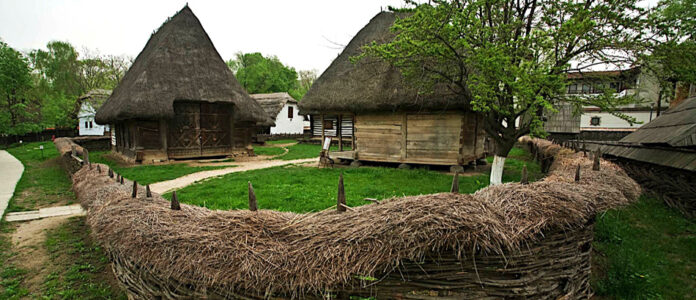
1. The National Village Museum “Dimitrie Gusti”
Description: One of the most beloved and visited museums in Bucharest, Village Museum is an open-air ethnographic museum that stretches on the shore of Herastrau Lake, offering a real journey through Romanian rural traditions. Inaugurated in 1936 by sociologist Dimitrie Gusti, the museum brings together over 360 authentic peasant houses, complete households and traditional buildings (wooden churches, windmills and water mills, oil presses, etc.) brought from all historical regions of Romania. Walkin ‘on its shady alleys, you pass through Transylvanian villages with shingle-covered houses and carved gates, then you get to the Oltenian plots with gazelles, to the brothels of the earth in southern Basarabia, to the rich decorated Maramuresian households or to the Shepherd cliffs in the Apuseni Mountains. Each household exposed is equipped with the area and period-specific tools, furniture and fabrics (17th century – inc. XX), offering visitors a genuine immersion in the life of the old village. The museum is organized as a park, with streets linking miniature villages, with gardens of flowers, fruit trees and even domestic animals (geese, chickens) sometimes, increasing the sensation of realism. It is a living museum: it often hosts crafts fairs, folk festivals, crafts workshops and gastronomical events, which makes the experience even more memorable.
Why is it special: The Village Museum is considered one of the first three open-air ethnographic museums in Europe (chronological order), and its collection is of exceptional diversity and value. Practically, in a 2-3 hour walk through all traditional Romania, from modest peasant houses to rural noble residences (like Casa Greceanu – boyar mansion since 1830). This outdoor presentation makes the visit very pleasant, especially on sunny spring or autumn days. The museum also offers a profound cultural perspective: each house tells a story about the way of life, the beliefs and customs of the people who lived it. For example, you can see a wooden Maramuresian church (18th century) with original paintings on the wallsAn impressive element that would otherwise have been lost in a depopulated village. The Village Museum is often characterized as “an oasis of tradition and greenery in the middle of the city”. For foreigners, it is an excellent way to discover the essence of rural Romania in a short time, and for Romanians, it is a nostalgic journey into the world of grandparents. No wonder it’s “the most visited museum in Bucharest”With hundreds of thousands of visitors annually.
Visitors experience: The tourists praise authenticity and picturesque to the museum. A foreign visitor notes: “Housed under the open sky, the Village Museum is the best place to understand Romanian traditional life; wanting along old houses and windmills feels like time travel”. Many also appreciate the interactive part – the possibility of actually entering houses, touching objects, seeing demonstrations of crafts (pottery, weaving at war, etc.). Families with children find the Village Museum both educational and fun: the little ones love to play in the houses’ courts, to look at fountains or windmills, as in a fairy tale village. Another aspect commonly mentioned is personnel dressed in folk costumes at events, ready to provide explanations or play the role of “hosts” in certain households. Also, the gift fair at the entrance is very popular – here you find from authentic and ceramics of Horezu, to sweetness and honey from local producers (a perfect addition of the visit). Most visitors recommend that you come to the Village Museum when there is a traditional holiday (Easter, for example) – the atmosphere is festive, with live folk music and the smell of cake in the air.
Useful information: The Village Museum is open daily (except on Mondays in the low season). Tickets cost 40 lei for adults (updated tariff 2025), 20 lei pensioners and 10 lei students / students. There are audio guidance available in several languages (an audio-guide can be rented from the entrance). As the area is large (almost 14 hectares), comfortable footwear and the allocation of at least 2 hours is recommended. The photograph is allowed (no additional fee for personal use). The museum also has a Traditional restaurant on the premises, where visitors can taste sarmals, belly soup or pies at decent prices (a lunch ~ 50 lei). First Wednesday of the month the entrance is free, which could be a tip. Being a beloved space, sometimes it can be crowded over the weekend – but the charm of the place remains.
Quote from a recent review: “The Village Museum is where you really feel the essence of Romania. The houses are real, brought together piece by piece from all corners of the country, and the walk among them, on the lake, is absolutely delightful. It’s like a charmed village in the middle of the city – a mustache-see of Bucharest!”. This enthusiasm is found in most reviews, with the Village Museum considered by many Objective number one of the capital, a place of soul that must not be missed.
Official link: museum-satui.ro (program, rates, events).
2. National Museum of Art of Romania (MNAR)
Description: Located in the former royal residence – Royal Palace on the Way of VictoryThe National Museum of Art of Romania is the main institution of plastic art of the country, offering a vast collection covering centuries of European and Romanian art. The museum is divided into two main galleries: European Art Gallery and Romanian Art Gallery (modern and medieval). Visitors walk through the sumptuous salons of the former palace (marble stairs, chandeliers, decorated ceilings) which constitute an impressive setting for the works exposed. The European Gallery (one of the best in Eastern Europe) includes works signed by masters such as El Greco, Rembrandt, Rubens, Monet, Cézanne or Rodinoffering a view from the 18th century to the 18th century. The National Gallery also delights visitors with masterpieces of great Romanian painters: Nicolae Grigorescu, Stefan Luchian, Theodor Aman, Gheorghe Tattarescu, Theodor Pallady and sculptures of Constantin BrancusiTo name just a few. The Romanian medieval art section displays ancient icons, frescoes, embroidery and silverware, putting in context the evolution of local art. Overall, the MNAR collection amounts to over 100,000 pieces, which makes it difficult to visit everything in a single day – but the museum organized the logical course, and the essential works are well valued. In addition to the permanent exhibition, MNAR frequently hosts temporary exhibitions of international caliber (also exhibited over the years works by Picasso, Dali, Matisse etc., borrowed).
Why is it special: MNAR is hosted in a palace of historical value – the former Royal Palace (originally built in 1837, subsequently extended), in itself an architectural monument. Thus, the visit is not only about art, but also about walking through the halls where the kings of Romania lived and where the key moments of history were held (e.g. the balcony where King Mihai greeted the crowd). But the piece of resistance remains wealth of collections, which gives a complete perspective on Romanian art – from Byzantine icons to paintings of interbelic modernists – while integrating it into the European context. It is practically a “must” for any art enthusiast visiting Bucharest: “Housed within the holding former Royal Palace, the museum offices a vast and diverse collection that spans centers of Romanian and European artistic heritage”, points out a summary on TripAdvisor. The MNAR is also the place where you can see live original Brancusi sculptures (SleepYour emails Prayer), which for many is a revelation – the works of the great sculptor are rare in Romania. The museum also houses symbolic masterpieces such as Grigorescu’s oxen wagonYour emails Luchian’s Aisbergs or Corneliu Baba’s “Gypsy de la Gherla”, works well known to any Romanian in textbooks or reproductions, which you see here in the original.
Visitors experience: Those who visited the MNAR particularly appreciate the establishment and explanation. The exhibition is very well curated, with bilingual labels (Romanian / English) that contextualize the works. The palace space gives the works elegance and brightness. A foreign visitor writes: “A treasure trove of art in an unexpected place. The European collection might be small but high quality (Rubens, El Greco), while the Romanian gallery was a revelation – I discovered impressive painters I never knew of”. Many admit that the discovery of Romanian art is the forte, entering without expectations and coming out pleasantly surprised by its originality and value. Also, tourists appreciate cafe and museum shop (where there are reproductions, albums, work-inspired souvenirs – a Brâncuşi magnet ~ 10 lei, a beautifully printed catalogue ~ 50 lei). Museum staff is often praised for their kindness and knowledge – there is the option to free guidance offered by young volunteers on the weekend, which creates a beautiful interaction. A practical aspect mentioned: visitors recommend the allocation of at least 2-3 hours for MNAR, being pretty much to see.
Useful information: The museum is open from Wednesday to Sunday. Ticket for permanent collections costs 50 lei in adults, 25 lei pensioners and 12 lei students (European + Romanian Gallery). You can only buy separate tickets for one of the galleries (~ 32 lei) or complete package with the Museum of Art Collections (another section of MNAR) at ~ 65 lei. There are audio tour on free mobile application (official MNAR audio guide). Photographing for personal use is allowed (no blitz in paintings). The first Wednesday of the month entry is free (opportunity known to the locals). Being central, easy access (Revolution Square) – you can combine visit with Athenaeum, Central Library etc. A note: A part of the National Gallery (medieval section) is on the ground floor in a darker wing – creating an environment suitable for icons, though contrasting with the light of the upper floors.
Quote from a recent review: “Probably the best art museum in this part of Europe. I was impressed by both the European collection and the Romanian collection – Grigorescu, Luchian, Aman, plus the sculptures of Brancusi – wow! And everything in a splendid royal palace. A must for art lovers”. This feedback summarises the majority perception: MNAR offers a world class experienceBy putting Bucharest on the map of important cultural destinations and offering visitors a double satisfaction – of art and history, in one place.
Official link: mnar.ro (programme, tariffs, exhibitions).
3. National Museum of Natural History “Grigore Antipa”
Description: For families and curious of all ages, the Antipa Museum is probably the most popular scientific museum in Bucharest. Founded in 1834 and fully reorganized in 2011, Antipa offers a fascinating incursion into the natural world, being famous for its realistic dioramas and vast collections of zoology, paleontology and anthropology. The museum is arranged on three levels: ground floor – Romania’s fauna, upstairs – global faunaand in the basement – history of life (fossils, dinosaurs, minerals) and ethnographic collections (exhibition “People of the World”). The famous diorama created by Grigore Antipa (the great naturalist who ruled the museum for over 50 years) was preserved and modernised, giving visitors the feeling that they look at animals in their natural environment. So you can admire, for example, Carpathian deer in a autumn forestYour emails pelicans on Danube DeltaYour emails snow zimbriYour emails lions and antelopes in African savannah or penguins in Antarctica – everything carefully reconstructed to detail and supplemented by ambient sounds in the deaf. Over 2 million pieces have the museum in deposits, and several thousand are exposed: from microscopic insects to huge mammals. The main attraction is, of course, complete skeleton of Deinotherium gigtissimum (prehistoric relative of the elephant, over 4 meters tall) discovered in Moldova – unique piece in the world. Also at Antipa you can see a dinosaur skeleton or the famous skull box Homo olteniensis (human fossil from Bugiulesti), and an impressive collection of butterflies and cockroaches Colour. The museum also has a powerful interactive component: touch-screen screens with information, digital maps, video projections (e.g. film of life evolution) and even educational games for children.
Why is it special: “Antipa” is not just a museum of showcases with stuffed animals – it’s a multi-sensory and educational experience who fascinated generations. The 2011 reopening brought it to modern standards, while maintaining its former charm (many adults visit it with nostalgia, also remembering childhood). Reputation It is unparalleled in Romania: it is considered a pillar of education and a must- see place in Bucharest for anyone who wants a break from traditional art and history. Both foreign tourists and locals praise the way information is presented attractive and understandable. A European tourism guide notes: “Its reputation as a pillar of education and wonder makes it a must- visit for travelers seeing to delve into nature’s secrets”. Evidence, in 2019, Antipa Museum was designated “The Most Loved Museum” in Romania in a survey. Other strength: The antipa manages to be captivating for visitors from 3 to 93 years. Children are fascinated by dioramas (polar bear or bat cave always exclaims), teenagers find new things (e.g. the interactive way of seeing human DNA), and adults can appreciate the scientific level of collections (rare exhibits of academic museum).
Visitors experience: Reviews are in overwhelming positive majority, with visitors highlighting the quality of the exposure and the pleasant nature of learning Here. A foreign tourist writes: “The Grigore Antipa Museum is highly recommended for visitors of all ages – engaging exhibits suitable for all ages, afferent ticket skills, and friendly staff who possess the dreamed experience”. Many mention friendly and well-trained staff – the custodian of the aquarium sector, for example, which answers children’s questions about fish. Families appreciate corner dedicated to children (where the small ones can draw or touch fur, snake skin, etc., under surveillance). In addition, the periodic temporary exhibitions at Antipa receive commendations – for example the exhibition of live tropical butterflies, or the exhibition “Venin” with tarantulas and poisonous snakes (separate but memorable fees). Visitors recommend avoiding weekend congestion if you can – on your days off, the queue at the entrance can be significant, sign of popularity. Another point raised: Accessible Prices and the feeling that you get a lot for your money – an adult ticket is ~ 20 lei, well below the rates of other capitals, and the quality of the exhibition is comparable to the great natural science museums in Europe.
Useful information: The museum is open daily (months closed). Entry ticket costs 20 lei for adults, 5 lei for children / students, 10 lei students and pensioners. Children under 3 are free. At the entrance there is a wardrobe where you can leave your bags bulky. The photo without the flash is allowed. The average visiting time is ~ 2 hours, but the passionate can stay and 4 hours to read everything. It also has a Aquarium with exotic fish (very loved by children) included in the tour. The museum is centrally located (Victoria Square), accessible by metro and light bus. Does it have a Little souvenir shop with educational toys, fossils on sale, etc. (prices from 5 lei – bug chain, up to 100 lei – skull replicas). Being very visited, tickets can also be purchased online in advance to avoid queuing. Periodic organisation Night in the Museum for children – an initiative where children sleep overnight in the museum, among dinosaurs, which shows how much Antipas has earned a special place in the heart of the audience.
Quote from a recent review: “Antipa Museum was a fantastic surprise – well organized, interactive and very educational. My children didn’t want to leave the giant skeleton of Dinosaur or the bear diorama. As an adult, I learned new things myself. A place where you learn by laughing and marvelling, it is worth every lion.”. For good reason, the Antipas Museum is perceived as a “must” of Bucharest, complementing the city’s cultural offer with a little bit of science and a lot of curiosity for the surrounding world.
Official link: antipa.ro (programme, tariffs, exhibitions).
4. National Museum of the Romanian Peasant (MNTSR)
Description: Located in a historic building in Victoria Square (former Palace of Arts, built in neo- Romanian style in 1912), Museum of the Romanian Peasant It is an original and living museum dedicated to the material and spiritual culture of the Romanian peasant. MNTSR is not a traditional museum but a modern museum space with an artistic and often unconventional approach of exhibitions. Its collections comprise over 100,000 objects: folk costumes, fabrics, ceramics, tools, icons on glass and wood, cemetery crosses, peasant furniture, carpets, surrounded eggs, etc., collected from all regions of the country. However, the presentation is not a dry one; the MNTSR exposes its treasures to Creativity-filled diaporomas – for example, in one room the folk costumes are placed as in one hora, in another collection of pottery is presented in the form of a wall “wallpaper” with plates, creating a special visual effect. Many halls are accompanied by explanatory and poetic texts (in Romanian, English, French and German) designed with humor and intelligence, “complicit” with the visitor, as the founder of Horia Bernea said. The museum’s path is conceived as a maze that passes through the fundamental themes of peasant life: birth, wedding, death, faith, earth work, decorative art, etc. Among the strengths: 18th-century wooden church fully mounted inside the museum (brought from Maramureș), an extraordinary collection of glass icons Transylvanian (some from 1800) rooms decorated as genuine peasant interior and a treasure of ceramics (including the famous “Horezu pottery” and prehistoric quartz). MNTSR is also known for cultural activism: it organises constantly fairs and peasant markets in his court (by Saints Michael and Gavriil, by Dragobete, by Saint Nicholas, etc.), bringing genuine folk craftsmen and traditional producers to the middle of the city. It also has a cinema hall (“Horia Bernea” Studio), a popular bistrocafe (Peasant’s Club) and an excellent handicraft shop.
Why is it special: The Peasant’s Museum is the laureate The 1996 European Museum of the Year Award – an international recognition of its originality, being the only museum in Romania with this title. His museum concept was considered revolutionary: to present traditions in a contemporary key, sometimes ironic, with exhibitions that do not “teach” teaching, but incite reflection. Thus, visiting MNTSR does not resemble any other ethnographic museum – it is a special cultural experienceThat makes you simultaneously feel awe for the ancient crafts and smile at the way of exposure. One example: at the entrance was (before renovation) a panel with the message “This museum is not for fools,” a provocative statement that remained legendary and defines the ludicrous attitude of the institution. As a depositary of national peasant identityThe Peasant Museum presents the “Romanian soul” in an almost artistic manner: through color, object, sound (traditional songs or wailing in certain halls are heard in speakers). For those who want to understand the Romanian ethos more deeply, MNTSR is the ideal place – as a review says: “Peasant Museum is the best place for those tourists trying to understand the history and traditional crafts of Romania”. The museum is not afraid to address sensitive themes either: it has exhibitions dedicated to rural communism, deportations, or the contemporary village in transformation. It’s a live museum and by being a cultural hub: hosts jazz concerts, film festivals (e.g. One World Romania) or modern art exhibitions inspired by folklore.
Visitors experience: Those who enter the MNTSR for the first time either fall in love or remain a little conflicted – but not indifferent. Opinions often mention warm and inspiring ambiance: a foreign visitor notes that he liked both the exhibition and the building and the yard: “Convenient location in Victoriei Square, Taran Museum is the best place to see Romania’s traditional soul… It is not a typical museum – the exhibition design is very creative”. Many praise the presentation of objects – like art installations. Foreign tourists also appreciate translations in four languages, often noting subtle humor of texts (e.g. explanations of naive stained glass or wood sculptures of dead-headed crosses). A consistent segment of the public is the local hipsters and artists, who find inspiration at MNTSR always – not for nothing it was called “a palace of popular art with modern spirit”. A highlight mentioned: Museum Store, considered one of the best places to buy authentic souvenirs – you can buy them hand sewn (150-300 lei), traditional ceramics (plates at 50-100 lei), glass icons (from 200 lei) or more accessible: books, traditional music CDs, cool country-motivated T-shirts (40-50 lei), bow ties and woven bags, etc. Besides, Peasant’s Club (Terrace) – museum tavern – it is very appreciated for the bohemian vibe, good food (bean soup, pies at 15-20 lei) and often live music. Basically, visitors feel at MNTSR not just a museum, but a cultural microuniverse where they can spend hours without boredom.
Useful information: The museum was fully reopened in 2022 after the renovation, with the permanent exhibition rearranged, so everything is in excellent conditions. Tickets cost 20 lei in adults, 10 lei pensioners, 5 lei students. There are audioguides included in the price (available in 3 languages) – very well done, worth using. The program is Wednesday to Sunday (Monday and Tuesday closed). Photography is allowed, without charge, and many are even encouraged to take creative pictures. The museum also has space for temporary exhibitions, so check on the site or at the entrance, there’s always something new (from documentary photography exhibitions, to contemporary art installations on rural themes). It is opposite Antipas, so many visit them on the same day, possibly with a lunch break at the Peasant’s Club.
Quote from a recent review: “The Museum of the Romanian Peasant does not resemble any other museum I have seen. Traditional objects are displayed as in a modern art gallery – sometimes you immediately understand the message, sometimes you have to sit and think. It’s full of color, irony and Romanian spirit. I came out of there feeling I understood something profound about the spirit of this people.”. This feedback confirms the status of MNTR as a museum of soul, deep and original, which gives visitors not only information but a state, an emotion – which certainly places them in the top 5 museums to visit in Bucharest.
Official link: the museum of the country of iroman.ro (program, events, tariffs).
5. Ceaușescu House (Spring Palace)
Description: An intricate incursion into Romania’s recent history, Casa Ceaușescu (also known as the Spring Palace) is the private residence of former dictator Nicolae Ceaușescu, opened as a museum in 2016. Located in a luxury residential neighborhood (Spring area), the real estate tax hides behind fences a Opulent and surprising universewhich contrasts strongly with the austerity of communist times experienced by the population. Built in the 1960s and expanded in the 1970s, the villa with over 80 rooms was the home of the Ceaușescu family (Nicholas, Elena and their children) – practically, a modern palace equipped with all possible comforts and extravagances at the time. The guided tour reveals the sumptuous rooms: specially ordered furniture salonsMarble stairs with golden balustars, crystal chandeliers, huge Persian carpets and original works of art on the walls. Each room has its personality: Ceaușescu’s office – relatively sober, bedrooms – ultra-luxurious, with sculpted beds and silks on the walls, winter garden – an inner greenhouse full of exotic plants and mosaics inspired by tropical landscapes. One of the famous attractions is Elena Ceaușescu’s bath room, famous for 24k gold-plated sanitary facilities and the ornamental mosaic on the walls – a symbol of the megalomaniac kitschs. The house has and indoor pool large, decorated with a mosaic depicting Neptune and his marine horses, plus sauna, cinema hall, wine cellar, even a antiatomic bunker Secret in the basement. The exterior of the villa is surrounded by a lush courtyard with garden and volleyball – in times populated by peacocks, pheasant and other exotic birds brought for the pleasure of the Ceausesti. The visit to Ceaușescu House is exclusively through guided tour, which provides professional access and explanations about the dictator’s way of life, security protocols, state visits hosted here and the story of the remaining objects in situ.
Why is it special: Casa Ceaușescu offers visitors the unique opportunity to “enter the privacy” of one of the most notorious leaders of the 20th centuryRight in the setting where he lived. It is a fascinating and contrasting experience: see Extravagant grandeur and taste of the leading couple, while knowing the context – an entire people who suffered deprivation (famine, cold, scarcity) in the 1980s, while the leaders ordered gold faucets. This contrast often sparks strong reactions to visitors – from indignation to perplexity and even ironic amusement. On the other hand, the Ceaușescu House is also a Time capsule – everything remained almost untouched since December 1989, keeping the atmosphere of the golden age of the communist nomenclature faithful: retro interior design, state-of-the-art Japanese audio-video apparatus (for those times), exotic souvenirs received by Ceaușescu (e.g. tiger skins, gift from Zambia’s leader). For young generations and foreigners, the visit is extremely revealing: “The mansion is an architectural gem, showing the best of Romanian craft combined with the luxurious keys of the Communist elite”, writes a visitor, surprised by the refinement of some of the decorations, but also by the extravagance not matching the egalitarian ideology of the regime. The guided tour reveals and numerous anecdotes: how Ceaușescu fed his own peacocks, how security protection was nonstop, how Elena’s huge dressing room looked, full of fur coats (exposed). Paradoxically, many visitors find the place more elegant and less kitschos than would have expected (thanks to some discreet restoration made at the opening), which contributes to the complexity of perception of the Ceaușescu couple.
Visitors experience: Guided tours (which last ~ 45-60 min) are extremely well-listed – guides are praised for their knowledge and for the balance between serious historical information and savory details. A foreign visitor writes: “The tour guide is amazing… gave an excellent and sarcastic commentary all the way around. We loved it., sign that guides do not shirk to approach the subject with humor. Many reviews highlight positive surprise: the exterior of the villa is quite simple and does not let the opulence inside be guessed – “Doesn’t look like much from the outside, but inside it’s very large and (for its time) very lush. To see how much splendour this dictator lived in…”. Thus, many consider the visit to Ceaușescu House as a highlight of the stay in Bucharest, offering a perspective unique on Romanian communism. And locals visit in large numbers, often driven by the curiosity to see “with their own eyes” how the leader they knew from TV lived – reactions go from nostalgia (in the case of some elderly) to cultural shock (in the case of young people born after ’89). Another aspect appreciated: unlike the Palace of Parliament (another attraction related to Ceausescu, but more impersonal), Ceausescu House customize history, turning the dictator from an abstract figure into a “almost tangible” character by personal objects. The tour is thus becoming memorable – as evidence, Casa Ceaușescu has excellent ratings on the tourism platforms and is often compared with the villas of other dictators (e.g. Tito’s villa in Belgrade) in his favor.
Useful information: The visit is possible only with organized programming / tour. Online reservation of the tour slot is recommended (especially during the weekend it deals quickly). Standard ticket price is 75 lei for adults, there are discounts to 60 lei for students and 45 lei for children (includes guidance in Romanian; the English guide can be a few dozen extra lei). Photographing is allowed (no flash), an appreciated bonus – everyone wants the picture in the golden bath or pool. The tours are available in Romanian and English (and sometimes French, with request). Program: sundays, 10: 00 – 18: 00. Parking in the area is difficult, taxi / uber is recommended or walking from the Aviatorilor subway (~ 10 min). A good idea is to combine the visit with a walk through the Spring district, where you can see other villas of the nomenclature (guides even point to the villas of former street dignitaries). At the end of the tour, visitors can browse a small souvenir shop that sells books about the Ceaușescu era, copies of propaganda posters, or old bills.
Quote from a recent review: “Incredible, shocking and exciting – this is how I would describe the visit to Ceaușescu House. The opulence of the interior left me speechless, considering how much the people suffered in those years. The guided tour was perfect, full of historical information and picanteria. It is an unforgettable experience for anyone who wants to understand the contrast between communist propaganda and the reality of the elite then”. Such theories confirm that Spring Palace quickly became a top attraction of Bucharestproviding a immersive and memorable historical experiencewhich perfectly complements the panorama of classical museums in the capital.
Official link: palace primaverii.ro (reservations, rates, information).
This article is an English translation and adaptation of the original Romanian article on Lista Scurtă. Read the Romanian version.

